life
Working Hard Does Not Get It Done: The Open Loops in Your Head
August 11, 2026 · 9 min read
A Perfect Memory, Right Up Until the Bill Is Paid
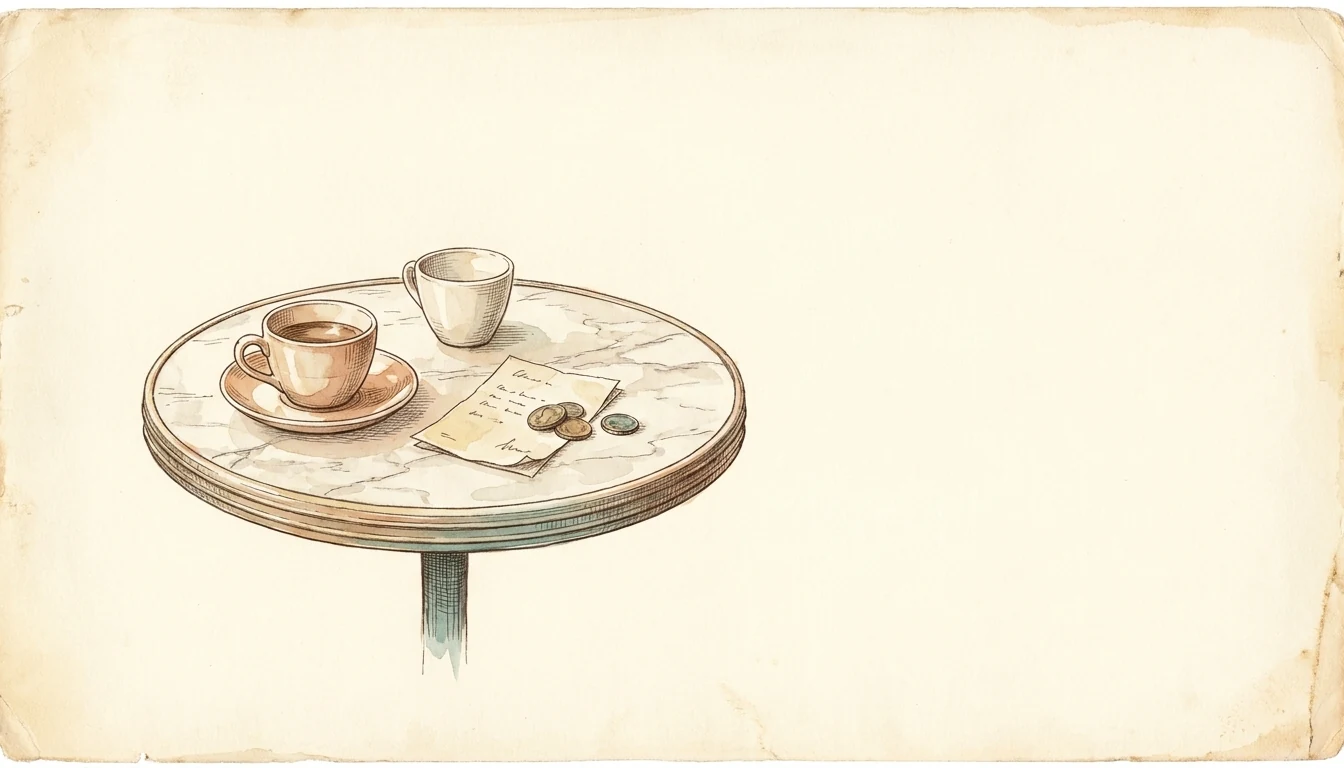
The way the story goes, it starts in a cafe.
The psychologist Kurt Lewin and his students were watching a large table place a long, complicated order. The waiter wrote nothing down. Dozens of items, who wanted what, which coffee took milk and which was black, all of it held perfectly in his head, all of it delivered without a single mistake. The meal ends, the bill is settled, everyone is about to leave. One of the students, half as a prank, calls the waiter back and asks him what had just been on the table. The waiter stares back, blank. That huge list, at his fingertips only minutes earlier, is gone.
One of the young researchers at that table was Bluma Zeigarnik. She read that blank stare not as a failure but as a clue. Why does the waiter remember everything while the tab is open, and forget it the moment it is paid? In 1927 she turned that hunch into an experiment. She gave people close to twenty small tasks. Some she let them finish, others she cut off halfway. Then she asked everyone which tasks they had worked on. The result was clear. People remembered the interrupted tasks about twice as well as the ones they had completed.
Today we call this the Zeigarnik effect. An unfinished task stays open in the mind like a bracket that never closes. It carries a small but stubborn tension, and that tension keeps working in a corner of your head until the task is done. The waiter’s secret was not a good memory. It was that the open tab held him. When the tab closed, the bracket closed with it, and his mind let go.
This Post Is Not Really About Waiters
It is not about memory experiments either. It is about why you come home in the evening exhausted, on a day when you did not really finish anything you could point to.
We all carry an equation in our heads, often without noticing it: working hard equals getting a lot done. The longer the hours at the desk, the more productive we are counted, and the more productive we count ourselves. But the equation fails even where work is easiest to measure. The economist John Pencavel studied factory data and found that once weekly hours pass a certain point, output per hour drops fast. Past that line the extra hours add almost nothing to what gets produced, and with the mistakes that come from fatigue, they start to subtract. Working more is, most of the time, not making more.
Working hard usually does not get the job done. It just occupies more of your mind.
To see why, you have to rethink where the tiredness actually comes from. Because on most days, what drains us is not the work we did.
The Mind Is a Terrible Warehouse
Our working memory is embarrassingly small. The psychologist George Miller described the limit years ago with a famous phrase, seven plus or minus two, and later research pulled the number lower still. What we can hold alive in the mind at once is barely a handful. Everything else hangs somewhere, waiting for us to come back to it.
This is exactly where Zeigarnik’s tension kicks in. Every unfinished task sits in the mind like an open tab, quietly burning energy in the background. One is harmless. But with fifteen tabs open at once, the mind turns into a low hum even if you have not touched any of them yet. When you move from one task to another, part of the last one comes with you. The researcher Sophie Leroy calls this attention residue. You are at the start of a new task, but a corner of your head is still stuck on the one before it. All day long, without ever fully doing a single task, you carry the residue of ten of them at once.
The real source of the tiredness is usually this: not the work you did, but the work you did not do and cannot forget. That unexplained weight that lands in the late afternoon, the low anxiety underneath it, is often the same thing. Nothing is in danger. Your mind is just worn out from holding dozens of unclosed brackets open at the same time.
So Where Do All These Tabs Pile Up
Every task you do not write down somewhere picks your mind as the only place to live.
Working without a plan, moving forward without notes, sounds free and fluid. In practice it means carrying the whole inventory inside your head. The mind is a terrible warehouse for this. It leaks constantly, it pokes you at the worst moment with “you were supposed to do that too,” and when you lie down at night it starts reading the entire list back to you from the top. The cost of having no plan is usually not the tasks that go undone. It is that inner voice that never goes quiet until they are.
Here a nice finding from psychology changes things. The researchers E. J. Masicampo and Roy Baumeister showed that you do not have to finish a task to release Zeigarnik’s tension. Making a concrete plan for an unfinished task, a simple decision about when, where, and how you will do it, was enough to close that open bracket in the mind. The task was still not done, but the moment the mind understood it had been handed to a place it could trust, it loosened its grip. In the same way, there are studies showing that people who write down tomorrow’s to do list before bed fall asleep faster. The list is what brings sleep, because the mind relaxes once it can pass the watch to paper.
What empties the mind is not finishing the task. It is finding the task a place it can trust.
That is exactly what the waiter was doing. He remembered the order because he had tied it to something, to the open tab. When the tab closed, he dropped the load. Our problem is that none of the tabs in our heads ever really close.
Two Places I Have to Be Honest
If I leave what I have written so far as it is, it becomes misleading.
First: that tension is not all bad. The grip Zeigarnik saw is the same thing that pulls you back to a half finished task and gets it done. A mind where nothing tugs at you, fully emptied, does not get anywhere either. The goal is not to kill the tension but to hold it somewhere outside your head instead of inside it. What makes the difference is not that the task disappears, but that you get to stop carrying it.
Second, and this one is sneakier: the plan itself can turn into an escape. You can make the to do list so pretty, so long, that making the list quietly takes the place of the work. A flawless weekly plan drawn in three colors of ink can leave you at the end of the day with that “I worked so hard” feeling, without a single real thing getting done. A plan exists to make the work visible. The moment it stands in for the work, it has lost the plot. As much as this post argues for taking notes, it argues just as hard against turning the note into a ritual.
A Deliberately Round Answer to “What Should I Do”
I am not going to put a clean prescription here, because there isn’t one. Someone who journals in the morning and someone who leaves voice notes at night do not settle down with the same method. Some people do better with one tidy system, others with paper scattered across the desk. If you are looking for a method that works for everyone, the thing you are looking for does not exist. If it did, we would all have found it by now.
The only general truth worth offering is not the method but the logic under it: dump the open tasks in your head into a place you trust, give each one a “next step” instead of a “finish,” and leave the rest to your own rhythm. To get a task off your mind, you do not have to complete it. You just have to know where and when you will come back to it.
At most, I can leave you a few questions to ask yourself now and then. Am I actually tired right now, or am I just carrying a lot of unclosed tasks at once? Do I really need to do this task, or am I only afraid of forgetting it? And at the end of the day: not what did I finish today, but how many open brackets did I manage to close into a safe place? No one but you can answer these, because only you know what your own mind needs to let go of in order to breathe.
Settling the Tab
The waiter in the cafe forgot the list the moment it was paid. What made him forgetful was actually the sign of a healthy mind: being able to let go of an account once it closes. Our problem is not a bad memory. It is the opposite. None of our accounts ever really close. Everything stays forever on an open tab.
But the mind does not always wait for a task to be finished before it counts it “closed.” It lets go the moment it knows where and when it will come back. You do not have to finish that huge list that wears you out at the end of the day. You only have to take each item off your mind and write it down somewhere you trust, the way the waiter let go of a settled bill.
Working hard is not a virtue, and it is not a measure. The real question is not how many hours you sat, but how many brackets you managed to close. And the tiredness, most of the time, does not come from the work. It comes from not being able to put it down.