maker
Dozens of Articles a Day, Zero Output in Six Months
September 15, 2026 · 8 min read
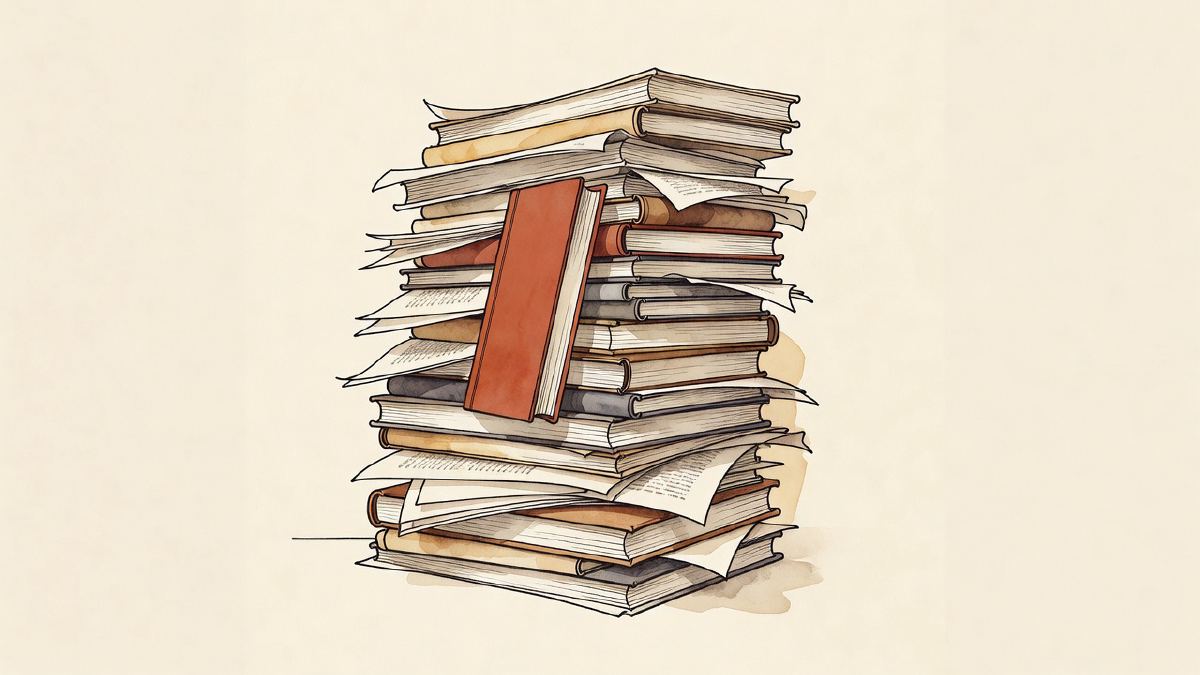
Dozens of Articles a Day, Zero Output in Six Months
In 1971 Herbert Simon wrote a sentence that became the design principle of every app you open today: an abundance of information creates a scarcity of attention.
Simon was talking about computers; he’d seen that information would get cheaper. But he called the real bottleneck correctly: what’s scarce isn’t information itself, it’s the attention needed to process it. Half a century later, that bottleneck is what your day looks like. Five newsletters, three podcast episodes, ten X threads. You finish all of them, note “I’ll read it later”, and in the evening you watch one more video.
You can defend this weekly routine: this article had a good section, I spotted that pattern in that podcast, the best tips from this newsletter were these. As if you learned deeply. As if you grew.
Six months later, ask yourself: is there a blog post you wrote and published this period? Is there an architecture decision you made end to end and measured the outcome of? Is there a new side project? Did you teach a team member step by step and watch them develop? Most of the time the answer is no.
Still, there’s a feeling inside: you’re improving. Because you consumed something every day, stayed informed every day. That feeling covers up a misconception.
Your Brain Says ‘I Learned’, but You Were Just Exposed
The brain wants a completion reward. Watch a video, finish it. Read an article, close it. Skim a newsletter, scroll past it. To the brain, that’s “done”. The reward region fires: a slight relief, a dopamine flicker. When you finish something, you feel you’ve learned.
But repeated exposure creates the illusion of learning. You saw a headline, saw it twice, skimmed the article. The topic now feels familiar. The brain processes familiar as “I know”. But do you really know the details? When you hit a problem, can you pull up that article’s content and apply it? Most of the time, the answer is no.
The “fluency illusion”, studied for years by Robert Bjork and his team, explains exactly this mechanism. When you read an article a second time, it feels more fluent. That fluency comes from familiarity with the text, not from knowledge settling in. But the brain can’t tell them apart. The act of finishing produces a dopamine signal: one more thing completed. Without application, writing, or teaching, that signal hangs in the air. Even pressing “mark as read” triggers it. The video ends, the blue check appears, “read” lands at the bottom of the newsletter. Notification counts, “episode complete” badges; they all feed the same psychology: finishing something and achieving something get mixed up. In those four minutes there was no coding, no writing, no discussion. The information passed through your mind and didn’t stay.
On the production side, things work differently. You write something, hit an error, fix it. You write code, it doesn’t run, you start debugging. It stays in your mind for weeks. Production is effortful, not fast, and its reward is vague. There’s no completion reward, only the question of whether you actually finished the job.
Today’s digital ecosystem is the commercial version of that scarcity from the opening. Newsletter headlines open with “the week’s most important development”. The YouTube algorithm already puts the next video on a similar topic in front of you. The X feed and the LinkedIn feed run on the same engineering: designed to carry you to the next piece of content. Infinite scroll, autoplay, “recommended for you” streams are all part of the mechanism. The platform is optimized to keep you in the feed. Scrolling a page is easier than finishing an article, and that’s exactly what the system wants: to keep you in motion. The “I’m learning for my career” cover gives this loop legitimacy. At the algorithm level there’s no difference between browsing a news site and reading an engineering newsletter; both are trying to hold your attention. What emerges is a market called the attention economy: your focus is the real commodity the platforms sell.
This structure feeds on a habit loop. After an intense day, the feeling of having fallen behind pushes you to open something. When you read and finish, you relax: I stayed current. The next day, the same trigger, the same action. The trigger-routine-reward loop in Duhigg’s model strengthens the “I’m making progress” feeling each turn, but nothing concrete changes. Each successful turn makes the next one more likely. The loop feeds itself.
Someone who reads ten articles a day for six months can still be standing in the same place at the end. If they didn’t encode what they read, didn’t write it, didn’t explain it to someone, the information flowed through their mind and left no trace. The weakening of the deep, single-topic focus muscle is the most invisible result of this process. Being able to read a ten-minute article doesn’t mean you can solve a forty-minute problem. Every short loop makes the next long loop harder. Every time this muscle goes unused, it gets a little weaker.
Ten Frameworks, Zero Depth
For a junior engineer, reading articles genuinely works. If they don’t know a new library’s API, they go through a tutorial and use it the next day. The knowledge gap closes.
For a senior, the situation reverses. For someone who has seen dozens of projects and made dozens of decisions over ten years, learning new syntax isn’t the problem. The real problem is taking that syntax and never using it on a real problem.
React, Vue, Svelte, Astro. Think of someone who has read the documentation for each, maybe written a hello world, but never made a real production decision in any of them. Breadth exists, depth doesn’t. They know ten frameworks, they’ve gone deep in none.
That breadth looks good on LinkedIn: every new framework name shared, every new article link reads like an expertise signal. But the number of posts on a profile and the number of systems built are not the same thing.
This breadth creates a fake competence. In standup you say “I know that topic”, but when someone who truly knows it asks, your answers stay shallow. You can’t answer the question “which trade-offs did you consider?”. Because you only read those trade-offs, you never lived them.
Every new article, every new video feeds the feeling that there’s still something you haven’t learned. The brain says “I’m staying current”. But if you’re current, why hasn’t your architecture decision changed in the last six months? Why is the code you produce identical to the code you produced a year ago?
Every hour spent consuming is an hour taken from producing. When consumption ends, what’s left in your hands is a shallow description of ten different tools. When production ends, what’s left is having solved a problem. They don’t carry the same mental weight. One gets forgotten, the other stays.
What did you produce in the last six months?
The Discipline That Connects Consumption to Production
The problem isn’t knowledge, it’s production; that’s the truth that’s surfaced so far. A few concrete rules can be built on this.
Opening a new article without taking an output from the current one means putting consumption ahead of production. The output can be small: a paragraph of notes, a test snippet, an answer to a question. If there’s no output, that article counts as unfinished; the old debt must be closed before a new one is opened.
A one-week consumption fast is also a measuring tool, not a rest. When newsletters, podcasts, YouTube, and X stay closed for seven days, the first two days bring restlessness; after the third day the mind starts latching onto something: probably a question that has been waiting while things piled up. When that question is caught and written down, you see what the seven-day silence was for.
Information that isn’t written or explained within 24 hours evaporates before it becomes permanent. This isn’t Feynman’s technique, just a discipline: if an article was read, a video watched, the next day you write something with what you have, tell someone, produce a piece of code. Information left without application was never learned; it was only exposure.
The metric should change too. “I read 47 articles this month” is soothing but proves nothing to anyone. “I produced 6 things this month” is less soothing, because it’s verifiable: those 6 things either exist or they don’t. A production record can be simple: every month, a list of what was finished, not what was read. After six months that list fills up in two ways; one resembles a reading list, the other a work list. They don’t fill with the same feeling.
This month’s question stays the same: not how many articles you read, but how many finished things are sitting in your hands?