leadership
A 'Computer' Used to Be a Person
August 9, 2026 · 8 min read
- John Glenn is sitting inside the Friendship 7 capsule, waiting to become the first American to orbit the Earth. Every number of the flight, every orbital angle, has been worked out by the most powerful machine of its day: the new IBM 7090. But right before launch, Glenn asks for something strange. “Get the girl to check the numbers,” he says. “If she says they’re good, I’m ready to go.”
That “girl” was Katherine Johnson. At NASA she was a “computer”, meaning a person who computes. Because in those years “computer” was not a machine, it was a job. People sitting at long desks, working out orbits by hand, on paper, most of them women. Glenn did not trust the million-dollar machine. He trusted the judgment of a person who could verify the machine’s output with a pencil.
This scene is real, and it became a good film too: the 2016 movie Hidden Figures. It tells the story of Katherine Johnson and the computers who worked beside her. If you haven’t seen it, consider it a debt this post owes you, add it to your list.
Within a few years that job disappeared. A “computer” was no longer a person sitting at the desk, it was a box sitting on top of it. But notice what was lost: the skill was not the point. What Katherine Johnson really did was know what to compute, sense whether a result made sense, smell when something was wrong. That skill did not vanish. It moved up: first into programming, then into engineering.
A title is a border line
“Computer” was a title, and it had one job: to describe where the border between human and machine happened to be at that moment. As the border moved, the title changed with it. This is not a new story. Today the same film is just running on fast-forward.
To understand the speed, you have to lay two old ideas side by side.
The first is Moravec’s paradox. In 1988, the robotics researcher Hans Moravec made an odd observation: it was easy to make a machine play chess, prove theorems, pass an IQ test. But making it do what a one-year-old does, seeing and understanding a room, walking, grasping the sentence “hand me that cup”, was nearly impossible. It sounds backwards, but the logic is this. The skills we think are hardest (abstract reasoning, math) are the newest in evolutionary terms, a few thousand years old. The ones we think are easiest (seeing, sensing, keeping your balance) are millions of years old. And precisely because they are old, they run so deep that they are hard to copy.
The second is the Lindy effect. How long something is likely to survive in the future is proportional to how long it has already survived. An idea that has stood for forty years will probably last another forty; a forty-day trend is forgotten forty days later. The old is durable, the new is fragile.
Stack these two and something clear falls out: Moravec’s paradox is really the Lindy effect for skills. The newer a skill is, and the more it is “named and describable step by step”, the more easily it gets automated and the more fragile it is. The older, more tacit, and harder to describe it is, the more durable. AI is moving right along this slope: it takes the most describable, most surface-level work first.
The jobs of the last three years
Now look at the recent titles. Prompt engineering: writing the right words to get a good output from the model. Then context engineering: giving the model the right context, the right data. Then loop engineering: instead of writing commands one by one, designing the loop that drives an agent toward a goal. There is roughly a year between each of them.
These are the very top of the Moravec slope: the newest, most describable layer. Expecting a job as procedural as “say the right magic word” to turn into a long-lived title is not realistic. And sure enough, it doesn’t. Loop engineering had barely been named before the tools started adding commands like “/goal” and burying that loop inside themselves. The skeptics who say “this is just automation with a new name” are telling a truth too.
But these are not junk
This is exactly where most people jump to the wrong conclusion: “If they go stale in a year, then they’re empty, I won’t bother.”
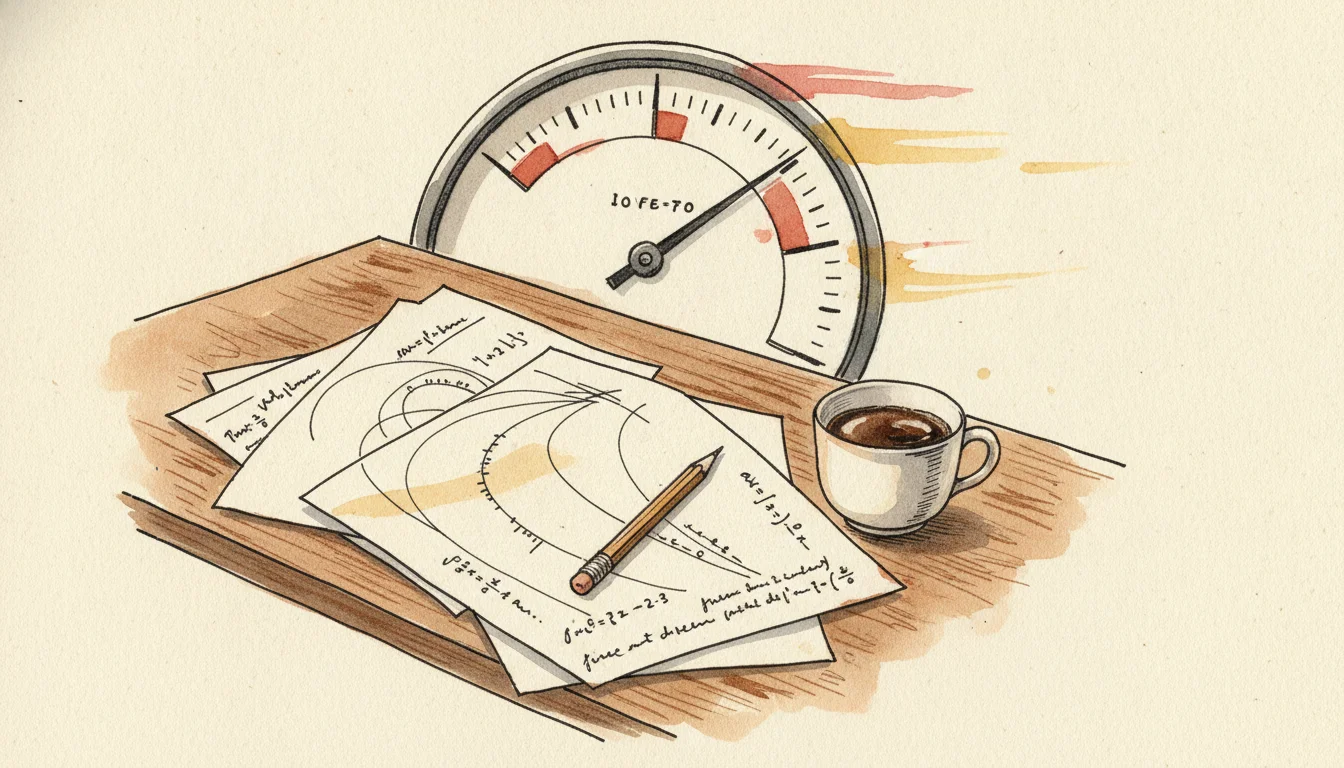
They’re not. The fact that these titles come and go this fast is not noise, it is a measurement. Each one is a milestone marking where the border between human and machine stood at that moment. Lined up together, they tell you one thing: how fast the border is moving. If we went from prompt to loop in a year, that is like the speedometer reading 200. Sneering at the gauge does not make the speed go away.
But there is a trap, and an old law of economics describes it exactly. Goodhart’s law: the moment a measure becomes a target, it stops being a good measure. If you read the title as a signal, it shows you the speed of the border; if you make it a target and say “I’m going to be a loop engineer”, that title no longer measures reality, it measures the thing you are chasing. The only way to keep a signal a signal is to hold it at arm’s length: close enough to notice the pattern, far enough not to game it.
The same principle works at a small scale too. The tokens you spend working with a model make your mental labor visible for the first time, labor that used to leave no trace anywhere, like a personal thermometer. But a thermometer shows the heat, not whether the meal is cooked. The moment you make your token count, or your title, into a target, both of them break. Tokens on the inside, titles on the outside: both are gauges to read, not medals to chase.
Two traps
There are two traps here, and both are faces of the same mistake.
The first is chasing: tying your identity to every new title, changing your profile headline every three months, mistaking knowing the latest term for mastery. This is staring at the gauge so closely that you forget to drive the car.
The second is refusing, and this is the sneaky one: “These keep changing, so I won’t invest in any of them, I won’t learn them.” It sounds mature, patient, even Lindy-minded. It isn’t. This is not durability, it is hidden slowness. The border is moving without waiting for your permission. While you say “I don’t take these seriously”, the people who are learning to read the border are passing you. And the stance isn’t sustainable either: once you build the habit of “not understanding the new”, you start a little further behind on every new wave.
The prescription: slow at the roots, fast at the leaves
So what is the right move? Moravec and Lindy hand you the same prescription.
At the roots, invest in the old and the hard to describe. Judgment. Knowing what matters. Sensing that a result “smells wrong”, just like Katherine Johnson. Synthesis, taste, reading people. None of these has a title, none has a certificate. And more than that, they don’t even show up in that token ledger: a counter can now catch your analysis, your experiments, your bug hunts, but no counter can catch the sentence you build while walking, the hunch that “something is off here”, the decision about which work you should never do at all. The most valuable part is exactly the part that shows up on no dashboard. And the more invisible something is, the harder it is for the machine to copy; that is what Moravec said forty years ago. This is your durable capital.
At the leaves, be fast. Learn every new title but don’t marry it. Get to know prompt, context, loop, and whatever comes next like weekend projects, understand what they are, note what they tell you about the border, then let them go. Roots grow slowly, leaves change every season. The healthy tree is the one that does both.
And stranger ones are coming
Be sure of this: today’s titles are not the last strange ones. Over the next few years we will hear names that sound ridiculous today. Some will live three months, some will be the seed of a new profession. You cannot know in advance which is which. But you can know this: if you become someone who can read them without clinging to any of them, you’ll be ready whatever name arrives.
Katherine Johnson started out as a “computer”. That job died, but she didn’t. Because her real work was never computing; it was knowing whether the numbers were right. That skill, no matter which box you put on the desk, is still someone’s job.
The Turkish version of this piece is here.