leadership
Why Kings Wear Purple: The Color You Cannot Make by Saving the Day
July 23, 2026 · 10 min read
The Color That Started with a Smell
The most expensive color in history was born in the worst-smelling workshops of the ancient world.
On the coast of today’s Lebanon there was a port city called Tyre. The geographer Strabo wrote two things about it, side by side: the city was very rich, and living in it was not pleasant, because it smelled. Both facts had the same reason. The city’s wealth came from dye workshops, built downwind of the town because of their smell.
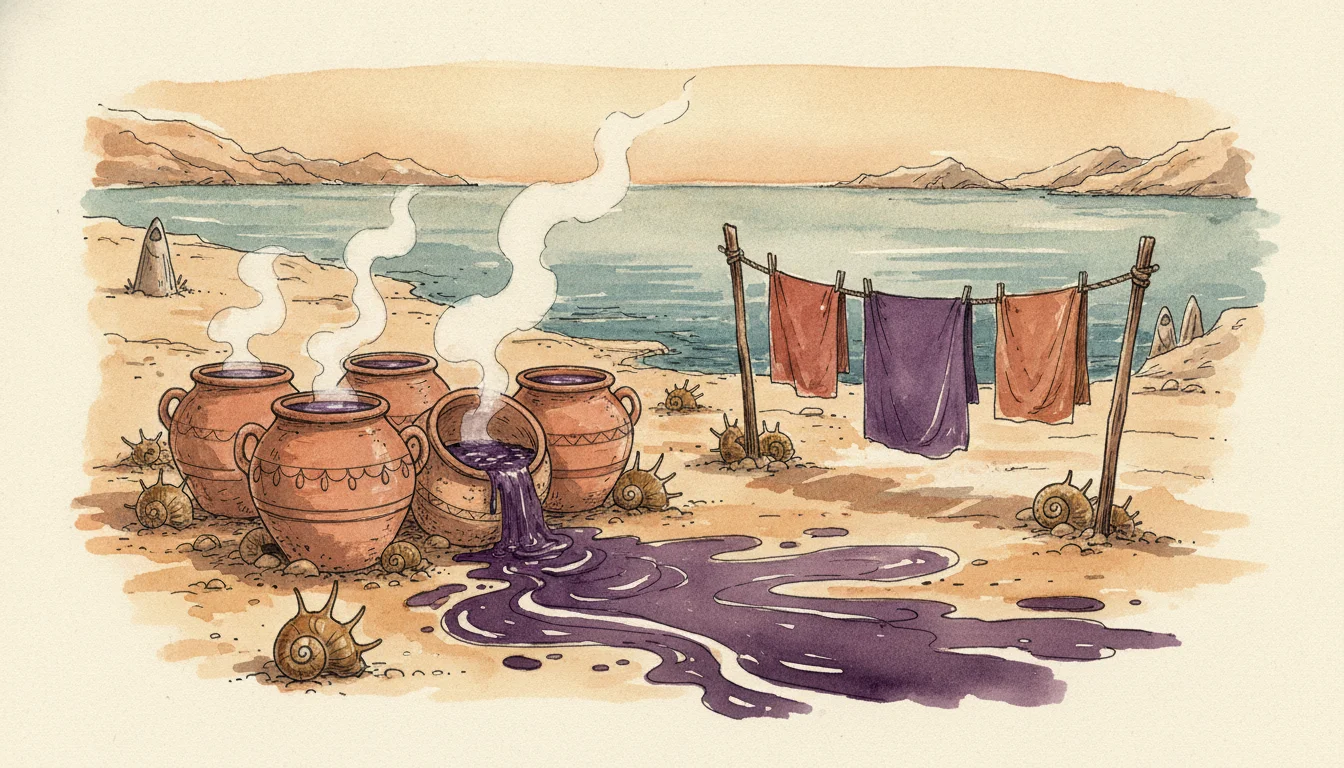
Those workshops produced Tyrian purple. The source was not a flower or a mineral; it was a spiky sea snail. Inside each snail there is a small gland holding one or two drops of liquid. That liquid starts out yellowish. With air and light it turns green, then blue, and finally a deep, rich purple.
The numbers tell the real story. In 1909, the chemist Paul Friedländer repeated the ancient process in his lab: from twelve thousand snails he got 1.4 grams of pure dye. Dyeing even the edge of a handkerchief needed thousands of animals and days of work. When the snail beds near their own coast ran out, the Phoenicians went looking for new bays; they spread across half the Mediterranean partly because of this snail.
Rome recorded the price officially. In Diocletian’s price edict, purple-dyed silk costs more than its weight in gold. Wearing purple was first a matter of money, then a matter of law; step by step, the color was tied to the palace. In the Byzantine palace there was a birth room covered in purple stone. Emperors’ children were born there and carried a title for life: born in the purple.
This post is not really about colors. It is about companies. But first we need to answer one question: how does a color become the symbol of an empire?
For One Gram of Purple
The answer is not difficulty. The world is full of difficult work. The answer is the type of difficulty.
Making purple was not a one-time act of heroism; it was a system from end to end. Boats and divers to collect the snails. Logistics to bring them to the workshop before they spoiled. Hands that removed, salted and rested the glands. Masters who waited by the vats for days and knew the exact moment the color turned. Tones tuned by controlling how long the dye saw the light. And all of this repeated, not once, but with the same quality in every batch.
Purple was not a recipe. Purple was a production system. Tyre’s real secret was not the liquid inside the vat; it was the order around the vat.
You cannot make purple with day-saving decisions. A workshop that collects snails today and gives up tomorrow, opens the vat early out of impatience, and changes its master every month will not produce purple. It will produce something, of course; but its name will be a stain, not a color.
My favorite detail is this: the color did not fade. According to Pliny, Tyrian purple did not run from the sun; it became more beautiful with time and light. Cheap dye washes out the first time. Purple shines as it ages.
Let’s put that sentence aside, because we will need it soon: a day-saving fix fades by the next morning; value produced by a system shines as it ages.
A Company Adrift in the Wind
Now let’s move from the vats to the meeting room of a software company.
Our industry loves a simple idea: speed is everything. Be agile, decide fast, catch the wind. Half of it is true, but the question is incomplete. Speed is only speed when there is a direction. Without direction, its name is drifting. Wind is not bad; wind is what moves the ship. The difference is the rudder.
I don’t need to describe the day-saving company in detail, because most of us have worked in one. The week’s plan is set by Monday morning’s email. The loudest customer becomes the roadmap. Every meeting is a fire meeting, and the word “urgent” has lost its meaning, because everything is urgent. After years inside the kitchen, I keep seeing the same two bills arrive.
First: you cannot invest in the right people. Hiring is a promise made for six months later. A company that does not know where it will be in six months cannot know who to hire; it collects firefighters for today’s fire. Then the fire changes, and the wrong team remains. Training, mentoring, watering a plant that will flower in six months… these are not luxuries. They are the natural reflex of a company with a rudder. Nobody packs supplies for a journey with no destination.
Second: nothing accumulates. In a day-saving company, every solution belongs to that day. The crisis passes, everyone goes home tired but happy, and next week the same film starts again. The solved problem is not written down, the lesson does not become a system, the knowledge lives in the hero’s head. Such a company has no memory; it has reflexes. And the difference between a reflex and a strategy is exactly the difference between a stain and purple.
The AI era did not soften this picture; it sharpened it. Every week a new model, every month a new miracle tool. For the day-saving company, each one is a new wind, which means a new course: one quarter a chatbot, the next quarter agents, the third quarter both left half-finished for that week’s demo. The purple story explains what is really happening here. When production gets cheap, the color itself loses value; the value moves to the dye house. AI made output cheap for everyone. Everyone has the color now. The difference is the production system.
I wrote before that AI is not a cheat code but a power tool. However light the steering gets, the question of where to go stays with the driver. A company that answers that question differently every morning is not really answering it.
The Hero Trap
Here I have to stop and be honest, because everything above would be unfair if I left it alone.
Saving the day is a skill. In the early stage it is almost the only skill. A startup that is still looking for its first customer, with three months of cash left, does not need a five-year masterplan discussion; that would be choosing curtains in a burning house. That period is called survival, and survival beats planning every time. For teams trying to cross the valley between prototype and product, sometimes the only right move is to keep swimming.
The problem starts when saving the day stops being an event and becomes an identity. The fire is no longer an exception; it is the operating model. And the company rewards it without noticing: the engineer who brings the system back at midnight gets the applause; the engineer who quietly works so that the fire never starts again gets “low visibility” in the performance review. Behavior flows to where the incentive is. A company that rewards firefighting is, without knowing it, raising arsonists. It is like the old story told about colonial Delhi: the government put a bounty on dead cobras, so people started breeding cobras, and when the bounty was cancelled the breeders released them all. The city ended up with more cobras than before. It is known as the cobra effect; a system that rewards the wrong thing produces the very thing it wanted to reduce.
The other side of the coin also kills: process worship. Companies that tie every task to a form, hold meetings about meetings, and cannot ship three lines of code without three signatures also die. They just die slower, and bored. The system I mean is not bureaucracy. A system is making a decision once instead of a hundred times, and letting the flow carry the rest. If the answer to “how do we deploy” lives in one person’s head, there is no system; if it lives in a script anyone can run, there is. It is that simple.
A Plan’s Job Is to Catch Luck
I can hear the objection: what if the market changes? We made a masterplan, and six months later it is trash?
It will change. Very likely. There is an old military saying: no plan survives first contact. People always use it as an argument against planning; but the man who said it did not run his armies without plans. The value of a plan is not that it comes true. The value of a plan is that it makes the deviation visible. The person who knows where they are going senses trouble early and prepares plan B. The person who does not know where they are going cannot have a plan B, because there is no plan A; there is only today.
The last act of the purple story says exactly this. In 1856 in London, an eighteen-year-old chemistry student named William Perkin was trying to synthesize quinine, a malaria medicine. The experiment failed. While cleaning the black sludge at the bottom of the flask, he noticed it dyed silk a bright purple. Mauveine, the first synthetic dye in history, was an accident. The color that had belonged to kings for thousands of years reached the shop windows of London within a few years.
At first sight, Perkin’s story destroys the thesis of this post: the man won by accident, not by plan. Look closer and the opposite appears. That year, hundreds of students in London were cleaning dirty flasks. The eye that noticed the accident belonged to a mind that knew what it was looking for. And what turned the accident into a patent, a factory and a whole dye industry was not curiosity; it was the system Perkin quickly built around it. Luck hits everyone. When luck hits a prepared system, its name becomes opportunity. When it hits an unprepared company, its name becomes a nice memory.
A pivot works the same way. Changing course is not the absence of a plan; it is knowing where you turned. Without a map you cannot change course. You can only drift.
Are You Making Purple, or Saving the Day?
When Constantinople fell in 1453, the palace workshops went silent, and the knowledge of true purple largely went with them. For centuries nobody could produce the color the old way. The secret of the vat died together with the master standing next to it. Knowledge that does not become a system is buried with its hero.
There are shortcuts to test which one your company is. I use three:
- The same-fire test. If the same problem caused a crisis twice in the last year, it is not an accident anymore. It is unpaid system debt.
- The vacation test. If one key person turns their phone off for two weeks, does the work stop? If it does, you do not have a company; you have a duty roster built around one person.
- The memory test. What written record remains from the last big crisis? If the answer is “everyone learned a lot”, nobody learned anything. They just got tired.
Working in the workshops of Tyre brought no applause. Enduring the smell, waiting by the vat, doing the same job a thousand times with the same care. Nobody carved those masters’ names into stone. But kings carried those masters’ patience on their shoulders. Purple is not the color of the day-savers. It is the color of the people who endured the smell.
The wind blows on everyone; these days, harder than ever. For the ship with a rudder, wind is fuel. For the one without, it is fate.